Co-authoring with Simon Edelhaus
 Idea lifecycle
Introduction
Being intelligent thinking human beings, we all get creative ideas. We want to see these ideas become reality. This is the way it has been with us, humans since the dawn of time.
Most of the time, nothing happens with our ideas. After a while, the idea gets discarded just like all the previous ones. Our experience tells us that it is impossible to implement these ideas immediately, in one shot. They are all a complex, long term puzzles.
Where ideas came from
 Idea generation - grape juice ready to ferment
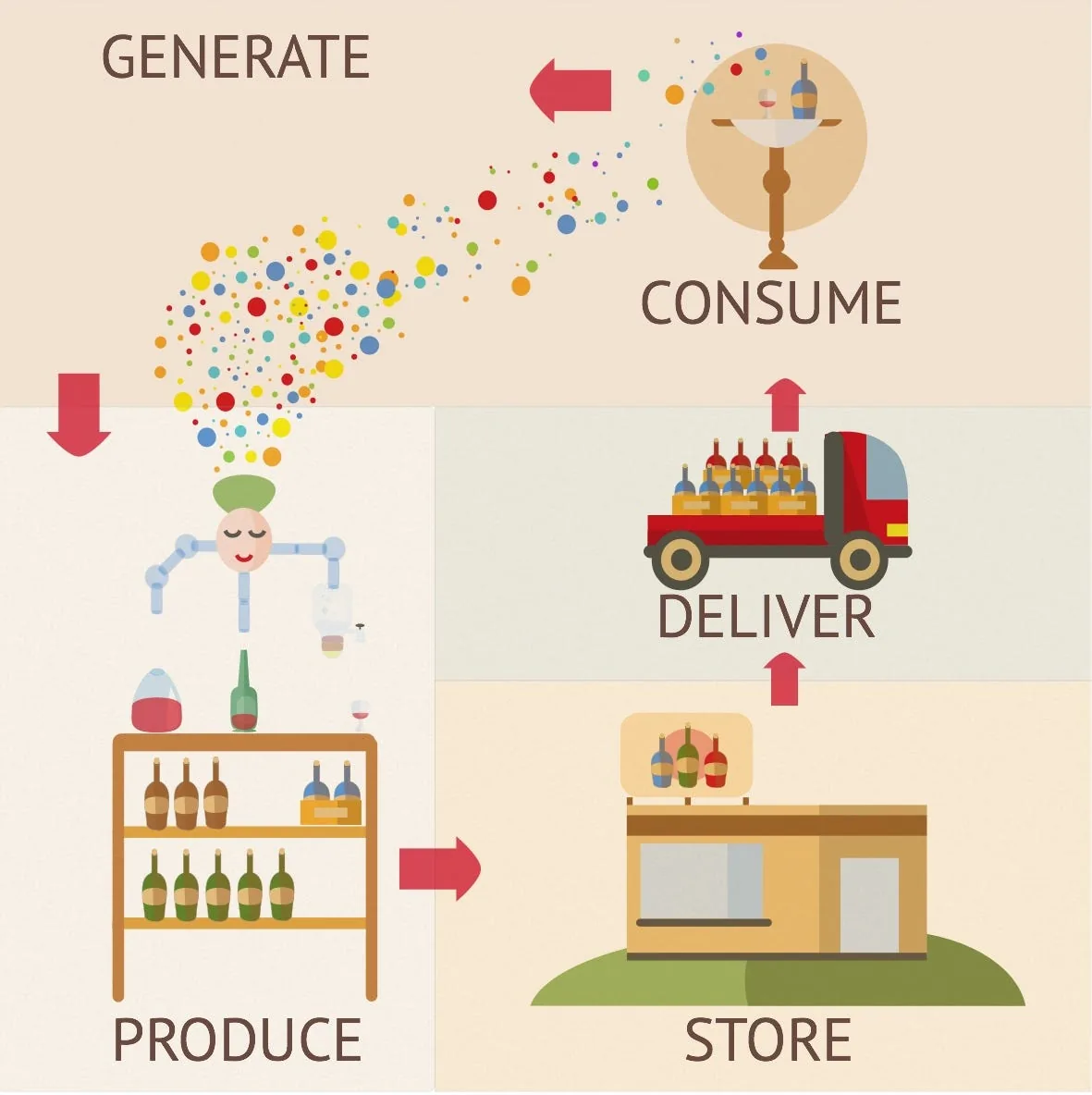
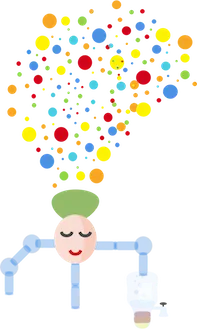
Our world is incredibly big, complex and multi-layered. This world furnishes us with hot new ideas in the weirdest places and at the most unexpected times. These ideas keep arriving, like grapes and grape juice to the cellar of a wine producer. Our goal, as accomplished winemakers, that produce wine from grape juice is to allow the quality of the idea to express itself to the outmost, through fermentation, blending and aging. The result is great wine…
Example #1
While swimming, you get the insight that the development process of your team will become more efficient if each task will be transferred from developer to developer either directly by the developers themselves, or by the QA or the Product Owner.
This could be done in a conveyor like manner - from one pair of hands to the next. Just like your hands work in tandem while swimming to keep the rhythm balanced, so would the development tasks pass in this “Zen Conveyor”.
Example #2
While standing in a small queue in a local coffee shop you start thinking that whilst awaiting, you probably, would enjoy some short ads in the background, because you are sort of “tuned” for it - you have 3 minutes nothing to do nothing to do, except think and get ready to buy another hazelnut latte.So maybe next time you can advise your marketing team to think about this “Waiting Time Gap for Ready-to-buy Cutomer” opportunity. But by the time you take your cup, the idea is buried withinh the sound of grinding coffee.
Essentially, ideas are like a special radio wave you can easily tune in to. But it is just as easy to change stations and let them drop and fade. Let’s accept this as a fact: there is an endless flow of ideas out there, which constantly gets filtered by our mind. The details of how this happens are a separate topic which was discussed extensively in a lot excellent articles about creativity, self-development etc…
What happens inside
 The fermentation filters of wine production
“Whoosh!”, a new idea just entered the “inside” of your mind. Ninety nine percent of the people don’t bother t0 develop or improve the idea at all. Often it is not only because of the effort involved in writing the details down, but also because of the difficulty most of us have with simply remembering things.
Ok, so there are ideas already in your mind… There are plenty of them. They came from different places. Things are pretty crowded “inside”.
Each “idea unit” is different at the ingress and the egress of this “inside”. The egress time of each “idea unit” is also different. Some of them may be deemed useless by the end of the day and get discarded. Others linger for a while. Many parameters are involved and things get complicated quickly.
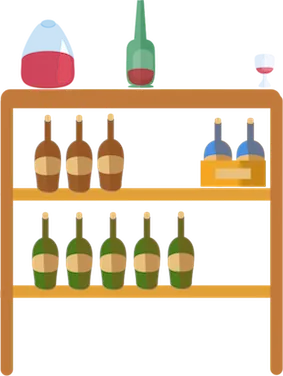
Let’s model the processing of the “idea units” and their racing “inside” from ingress to egress after a set of filters in our head. These filters, just like fermentation barrels in the cellar of a vineyard, help our ideas get fermented correctly and become a decent wine ready for consumption.
Time
Is the simplest filter. Come back to any of your ideas a day later. Could you make a good wine from it? Or are they just a amateurish sour grape juice material? Do you want to be a sour grape juice maker or a wine maestro ?
Don’t be scared to be strict. If the time for this particular variety of vino did not come yet, you will realize it quickly. If this time will never come - you will realize it as well, soon enough. The best thing to do is not to get hung up on it.
Decent wine will not come out of it. It can always be sold as grape juice at the store.
Sommelier
There are always top-rated wine makers out there. Get their advice. If it is possible - let them degustate. Sommeliers don’t steal recipes. They know a lot about wine-crafting. This is how they gained the respect of the industry.
It is not that easy to find your sommelier. But you have to do it. This is the only way to enhance your wine-making skills. Remember - the sommelier is most often your best filter!
You
You, and only you, have to be the final filter for your idea. If the grape juice has fermented this long, it is already wine that went through “primary fermentation”, and it is time for you to take the first sip. So go ahead and taste it! Spend some time and effort on the idea… If the wine still tastes wrong you will feel it right away. Then it is either time for “mid-process tweaks”, or a quick demotion to a cheap dessert wine.
If on the other hand, it is dark and dry, tastes quite good and you are ready to show it to a wider audience and start “secondary fermentation”, you will realize it as well without any further help or hesitation at this point.
Your wine cellar
 Your wine cellar and distribution point
Not everybody is Elon Musk. We should always be honest about the ultimate capacity of our wine cellar. Founding and running multiple hugely successful and exciting companies is only something a superbly gifted wine maker can achieve. We should accept it as a norm that we will never be able to save every successfully filtered “idea unit” and bring it to production. In wine production we should only worry about two things:
- What “grapes” and grape juice you get
- How much of them you get at a given time
Know your cellar’s capacity! If you are overwhelmed, it will lead to a mess. For sure, you are driven to fill shelves with wine bottles, barrels with fresh grapes to ferment, new and relevant exciting stuff. More and more and more…
Sometimes you feel held back by the old stuff which is “wasting” in the corner. But that stuff needs to be handled too, or you will soon have a general, cellar wide problem.
Be strict and objective. Better to increase the quality than amount. High end wines are always valued much more and pay for themselves many times over. But even a cheap white wine or a dessert wine that sells large volumes in the local supermarket requires time and effort to produce, otherwise it is grape juice and will still be sold as such.
Do not drink your wine alone
 Building a good multi stream logistics system
You make wine in order to drink it and let others enjoy it as well. Regardless of if the wine is going to make you rich, or just improve a simple agile development process for your team - the wine that made it thus far should always leave your wine cellar.
Create and maintain the delivery and logistics for those dusty bottles. Good distribution to the customer is a critical stage of the wine-making cycle.
 The epitah - consumption!
Even rare collection wines get open and drunk on occasion. A wine than never gets into the hands of the customer and from there eventually into their stomachs, is not worth making. Be it a cold winter night in front of the fireplace, or a happy anniversary dinner - the wine that made it to the customer will get opened and consumed. It might get consumed by the customer’s trash can, but that is just another way for the customer to express their opinion about that particular “idea unit” that you fermented and bottled.
Proportions, strategies and tactics
The provident winemaker will always think about stock selection, pest management, pruning, fertilization, irrigation and trellising in the vineyard. He will supplement poor year’s harvest with carefully chosen grape juice bought outside. He will always have slots in his storage for new green-glass bottles and oak casks.
The provident winemaker will always look ahead and plan. Planning causes success and it is well known that once you become a winemaker, you always want to grow and improve your business. Winemaking requires the right mix of planning, strategic thinking and learning to balance them with tactics.
The provident winemaker always give away his products for degustation. He intuitively knows the value of his product and the price to charge for it. He takes care to build the brand while always staying devoted to his art.
Summary
You should always make great wine! Be humble and open minded, ready to learn and collect new techniques. Do not compromise on your “inner essence”. This is what you will always have and be proud of when a lot of wine will “pass through you” and you will become a pro-wine maker. It is priceless, it precedes you everywhere you are, and eventually will supersede you once you are no more.
A common truth in winemaking is that some wines outlive their creators. So forward, onwards and updwards! Your сhâteau is awaiting you!