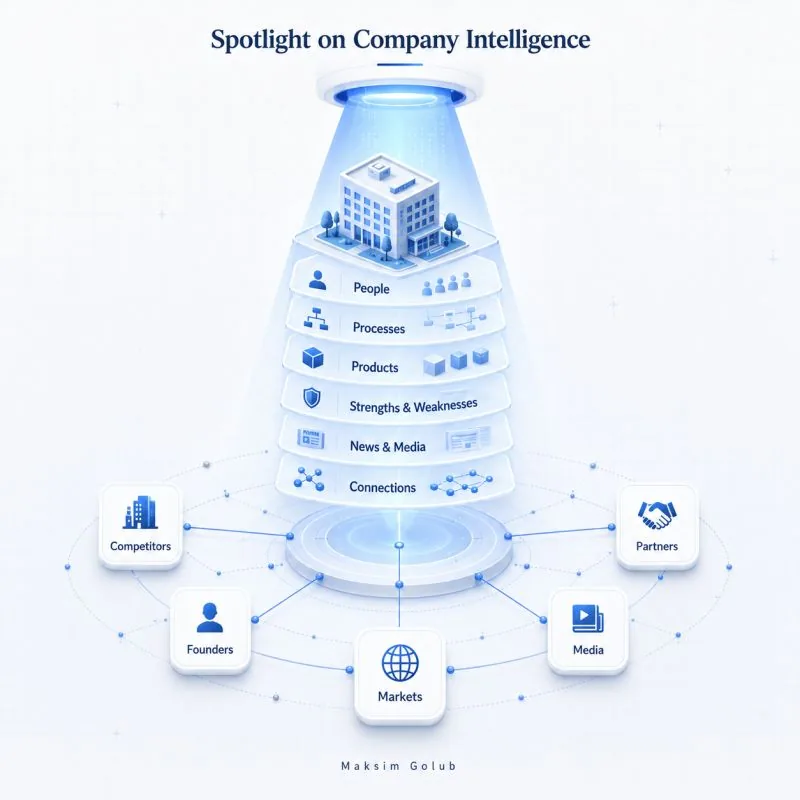
I’ve been thinking about company research less as an “AI skill” and more as a repeatable script. Hype comes and goes. What stays useful is a structure that can consistently answer the same questions: what this company is -> who built it -> how it makes money -> what people are inside it -> what it has done so far -> what it is likely to do next -> and who it is connected to.
The same approach works for people too. If you’re evaluating a founder,candidate or competitor, the job is similar: collect the right signals and turn them into something readable ~ actionable.
The interesting part starts after the collection. Raw research is only the base layer. The real value appears when you put a lens on top of it. In one case, that lens is competitive intelligence: where they are strong or weak, what share of the market they might control, what they do better than you, what can be borrowed, and where they are exposed. Suddenly the output is no longer “here is a dossier.” It becomes “here is what matters, here is what to watch, and here is what to do next.”
That is why I like building these systems as living maps. A company should be seen in context: against other companies, people, markets, and places. Once you do that, research stops being a background task and becomes an operating tool. Good intelligence is not about admiring the data. It is about making better moves from it.